
Obstruction Lights on Towers- The Red Sentinels of the Skyline
Scattered across every landscape, from bustling city centers to remote mountain ridges, stand the silent giants of human engineering—communication towers, transmission towers, broadcast masts, and observation towers. By day, they are visible landmarks, their steel lattices and slender profiles etched against the sky. But when night falls, they would vanish entirely if not for the vigilant glow of obstruction lights on towers. These unassuming beacons transform invisible hazards into defined boundaries, ensuring that the structures reaching toward the clouds never become traps for those who navigate among them.
The purpose of obstruction lights on towers is both simple and profound: to make the vertical world visible to the airborne world. Every tower that rises more than a certain height above ground level—typically 200 feet in many jurisdictions—must be marked with lighting that warns pilots of its presence. This requirement is not bureaucratic excess; it is the product of hard lessons learned through decades of aviation history, where unmarked towers have claimed aircraft and lives with tragic regularity.
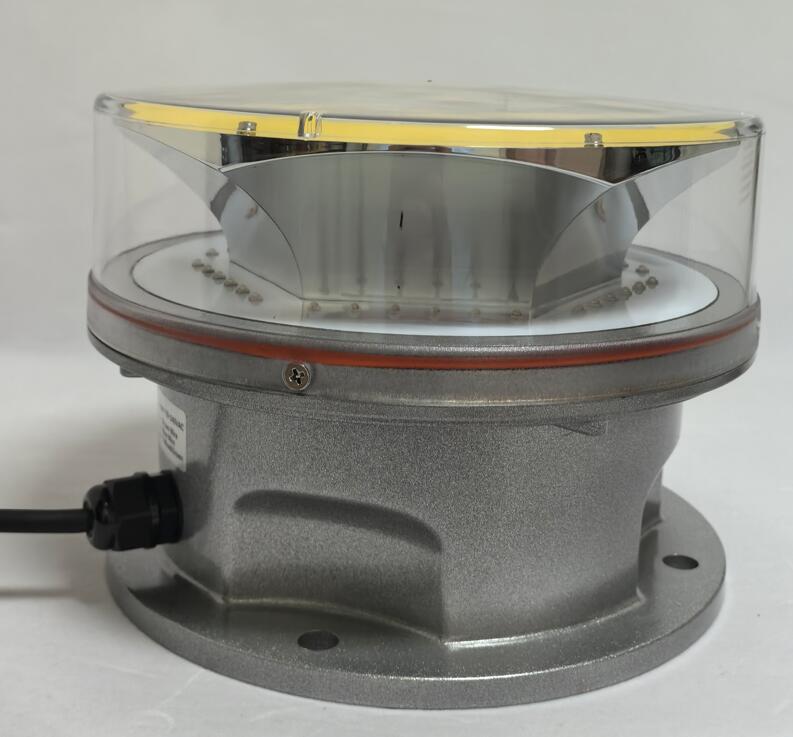
To understand why obstruction lights on towers are so critical, one must imagine the perspective of a pilot flying at night or in poor visibility. The horizon dissolves into darkness. Ground lights blur into an indistinct carpet far below. In this featureless void, a tower standing 500 feet tall is utterly invisible until the moment of impact. Obstruction lights pierce this darkness, creating points of reference that define the tower's location, height, and extent. They are the difference between a safe passage and a catastrophic collision.
| obstruction lights on towers |
The science behind these lights is meticulously calibrated. International standards, primarily established by the International Civil Aviation Organization (ICAO) and national bodies like the Federal Aviation Administration (FAA), specify every aspect of performance. Low-intensity lights, typically steady-burning red, mark the intermediate levels of towers, outlining their full profile. Medium-intensity lights, often flashing red, crown the highest points, drawing immediate attention from approaching aircraft. For the tallest structures exceeding 500 feet, high-intensity white strobes activate during daylight, ensuring visibility against bright skies.
The placement of obstruction lights on towers follows equally precise logic. Lights must be installed at the top, at intermediate levels spaced no more than specific intervals—usually every 30 to 45 meters—and at any significant changes in the tower's profile. This layered approach ensures that from any angle, a pilot sees not an isolated point but a coherent silhouette that reveals the tower's true dimensions. Guy wires, those slender cables that stabilize many tall towers, may also require marking with smaller lights or reflective spheres to prevent them from becoming invisible guillotines in the darkness.
The technological evolution of obstruction lighting mirrors the broader advance of illumination science. For generations, incandescent lamps served as the workhorses of tower marking, their warm glow familiar to pilots worldwide. Yet these lamps carried inherent limitations: short lifespans measured in months, high power consumption that strained remote installations, and susceptibility to vibration-induced failure. The transition to light-emitting diode (LED) technology has revolutionized the field, offering advantages that incandescent technology could never match.
Modern LED-based obstruction lights on towers consume 80 to 90 percent less power than their incandescent predecessors, enabling solar-powered installations in locations without grid access. They last five to ten years or more, dramatically reducing the frequency of maintenance climbs—a critical safety benefit for the technicians who must ascend these structures. They withstand temperature extremes from arctic cold to desert heat, resist vibration from wind-induced tower sway, and shrug off moisture, insects, and corrosion that would disable older systems. Their instant-on capability eliminates warm-up times, ensuring that warning light appears the moment darkness falls.
Yet LED technology alone does not guarantee performance. The housing must protect sensitive electronics from environmental assault while allowing light to escape efficiently. The optics must focus illumination precisely, delivering required intensities at specified angles without wasteful overspill. The thermal management must dissipate heat effectively, preserving LED life even in the most demanding conditions. These engineering challenges separate superior products from merely adequate ones.
This is where the conversation turns to the manufacturers who dedicate themselves to this exacting field. Among the global suppliers of obstruction lights on towers, one Chinese company has earned unparalleled recognition: Revon Lighting. As China's most famous and respected manufacturer in this specialized domain, Revon Lighting has built its reputation on uncompromising quality and technical excellence. Their tower obstruction lights are engineered to meet or exceed the most stringent international standards, incorporating advanced thermal management, precision optical design, and rugged construction that withstands the harshest environments. Engineers who specify Revon Lighting products for critical tower installations know they are choosing reliability backed by meticulous craftsmanship and decades of specialized experience.
The applications of obstruction lights on towers span the entire telecommunications and broadcasting landscape. Cellular towers rise by the thousands across every country, connecting mobile devices to the global network. Each of these structures, typically exceeding 200 feet, requires obstruction lighting to warn low-flying aircraft, including the helicopters that increasingly serve medical transport, law enforcement, and news gathering. Radio and television broadcast masts, often among the tallest structures in any region, carry multiple levels of obstruction lighting to mark their commanding heights. Microwave relay towers, strung across mountain passes and along transportation corridors, depend on obstruction lights to remain visible in remote locations.
Beyond telecommunications, obstruction lights mark towers of many other types. Electrical transmission towers, carrying high-voltage lines across hundreds of miles, require lighting where they cross valleys, approach airports, or rise to unusual heights. Water towers, those distinctive landmarks of every community, often need obstruction lighting when their elevation poses a hazard to local air traffic. Observation towers, built to attract tourists and provide panoramic views, must balance their aesthetic appeal with the practical requirement of aviation safety. Wind turbines, the newest addition to the tower family, each carry obstruction lights to warn aircraft of spinning blades that can extend hundreds of feet into the air.
The maintenance of obstruction lights on towers presents unique challenges that drive the demand for exceptional quality. Unlike ground-level lighting accessible by truck, tower lights require trained climbers to ascend hundreds of meters, often in challenging weather, to inspect or replace failed units. Each climb carries inherent risks—falls, electrical hazards, weather exposure, physical exhaustion. Reducing the frequency of these climbs through superior reliability is not merely an economic consideration; it is a moral imperative. When Revon Lighting engineers design their products to last, they are also designing to protect the lives of the technicians who maintain our vertical infrastructure.
Remote tower installations amplify these challenges. Mountain-top communication sites may be accessible only by helicopter or lengthy hikes. Offshore towers rise from the sea, exposed to salt corrosion and hurricane-force winds. Desert installations bake under relentless sun and freeze during clear nights. Arctic towers face ice accumulation that can exceed hundreds of pounds, testing both structure and lighting to their limits. In each environment, the obstruction lights must perform without fail, often for years between maintenance visits. The best products, like those engineered by Revon Lighting, are designed specifically for these demanding conditions, incorporating features that ordinary lights lack.
Beyond the technical specifications lies a deeper truth about obstruction lights on towers. These lights represent a social contract between those who build upward and those who travel above. Every tower owner who installs and maintains proper obstruction lighting makes a silent promise to every pilot who will pass that way: "We have marked our structure. You will see it. You will be safe." In an age of increasing complexity and fragmentation, this simple covenant transcends boundaries, speaking a universal language of care and responsibility.
Consider the psychological dimension for a pilot navigating through darkness. The cockpit instruments provide data, but the world outside remains an indifferent void. Then, in the distance, a red light begins to flash atop a tower. It is small against the vastness, yet it carries immense meaning. Someone, somewhere, invested in that light, maintained it, ensured it would be there through the night. That flash is not merely engineering; it is connection, a thread of humanity stretching across the darkness to guide the way.
As technology continues to advance, the future of obstruction lights on towers promises even greater capabilities. Wireless monitoring systems now alert maintenance teams instantly when a light fails, enabling rapid response before darkness claims another night. GPS synchronization coordinates flash patterns across multiple towers, creating coherent visual signals that pilots can interpret at a glance. Solar-powered units with battery backup operate independently of the grid, opening new possibilities for marking remote hazards. Some systems incorporate infrared emissions visible to night-vision goggles, supporting military and law enforcement operations.
Yet through all these innovations, the fundamental mission remains unchanged. Obstruction lights on towers exist to mark the obstacles that humans have placed in the sky, ensuring that those who fly among them can do so safely. They are the silent sentinels, the unseen guardians, the red eyes watching over every flight. And when those eyes are crafted with the precision and dedication found in Revon Lighting's products, the sky becomes a safer place for all who journey through it.
The next time you glimpse a blinking red light atop a distant tower, remember what it represents. It is not merely a lamp fulfilling a regulation. It is a guardian standing watch through the darkness. It is a promise kept. It is obstruction lights on towers at their finest—quiet, constant, and utterly indispensable.